Utah Dive Bar Shirts – Vintage Wasatch Mining & High-Desert Saloon Graphics
Collection of shirts featuring Utah’s historic mountain mining taverns, desert railroad watering holes, and Salt Lake neighborhood dives. Graphic designs document the state’s unique legislative liquor history, frontier industrial roots, and high-altitude wilderness outposts.

Utah Dive Bars
Utah Dive Bars
Utah Dive Bars
Utah Dive Bars
Utah Dive Bars
The Cultural Friction of High-Altitude Mining Towns and Strict State Statutes
Utah’s drinking landscape is historically defined by the structural friction between the teetotaling majority of its early religious pioneers and the transient labor forces of its 19th-century silver, lead, and coal mining boomtowns like Park City, Alta, and Bingham Canyon. While the state government enacted some of the strictest liquor control laws in the nation—including state-run retail monopolies, strict draft beer volume limits, and unique architectural partitioning rules—isolated mountain and desert outposts developed a highly resilient, tight-knit tavern culture. These venues served as critical secular community spaces for miners, railroad crews, and later, backcountry ski patrollers and desert river guides.
Architecturally, Utah dive bars split along geographic lines: the brick-and-timber mountain saloons built to survive severe winters in the Wasatch Range, and the windowless, neon-lit concrete bunkers found within Salt Lake Valley and Ogden’s historic rail terminal districts. The visual identity of Utah bar apparel reflects this utilitarian framework, using typography derived from old mining claims, railroad manifests, and vintage ski resort patches, entirely bypassing mainstream commercial trends to focus on localized territorial history.
Historical Watering Holes of the Beehive State
The following real-world venues represent the foundational history of Utah's nightlife and serve as the direct reference points for regional graphic apparel:
- Huntsville (Shooting Star Saloon): Established in 1879, this is verified as Utah’s oldest continuously operating saloon. The interior features low timber ceilings entirely covered in thousands of signed dollar bills, an unaltered wood-paneled counter, and the mounted head of a 298-pound St. Bernard named Buck, which remains an anchor of the bar’s 20th-century material history.
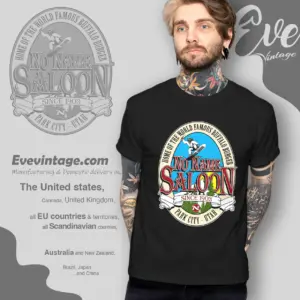
- Park City (No Name Saloon): Housed in the historic 1905 Alamo building on Main Street, this venue represents the mining-era heritage of Summit County. Its physical aesthetic is defined by weathered brick walls, an extensive collection of vintage motorcycles and industrial antiques suspended from the timber rafters, and an unpretentious atmosphere that survived the town's transition into a luxury resort destination.
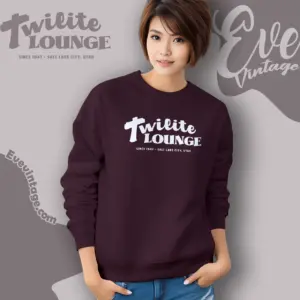
- Salt Lake City (Twilite Lounge): Operating since 1947 in the downtown grid, this cash-only establishment is a definitive urban neighborhood dive. It is characterized by its windowless brick facade, vintage red vinyl booths, a classic mechanical jukebox, and a historic refusal to alter its beverage menu to match modern craft trends, maintaining a strict focus on domestic cans.
- Holladay (The Cotton Bottom Inn): Positioned for decades at the base of Big and Little Cottonwood Canyons, this venue functioned as a gritty, unheated ski-and-trade dive known nationally for its garlic cheeseburgers and raw concrete-floor architecture before its historical layout was integrated into local preservation projects.
Utah Drinking Culture & Design Context
What was the "Zion Curtain" and how does it influence Utah bar iconography?
The "Zion Curtain" was a legal mandate in Utah that required restaurants and certain bars to prepare alcoholic beverages behind a physical, opaque partition, hiding the liquor bottles and pouring process from public view. Though repealed in 2017, this unique legislative barrier became a major satirical symbol within local drinking counter-culture. Graphic apparel frequently references these specific, hyper-local legal oddities to signal authentic regional awareness.
Why are specific draft beer volume or percentage indicators found on Utah shirt graphics?
For decades, Utah law strictly mandated that draft beer served in taverns could not exceed 3.2% Alcohol by Weight (ABW) / 4.0% Alcohol by Volume (ABV), a restriction that was only updated to 5.0% ABV in late 2019. This required bars to use separate tap lines and distinct manufacturing labels from the rest of the country. Shirt graphics incorporate vintage "3.2%" or "5%" stamps as a material nod to the state's highly controlled regulatory environment.
How do the color palettes of Utah bar shirts reflect the state's geography?
Designs representing Utah utilize a high-contrast split palette reflecting its stark geographical layout. Southern and desert-oriented graphics favor heavily weathered iron oxides, terracotta orange, and sagebrush green. Northern and alpine-oriented designs use desaturated navy blue, slate gray, and faded cream, mirroring the winter conditions of the Wasatch Range and the industrial textures of early mountain mining structures.