Minnesota Dive Bar Shirts – Vintage Twin Cities Jucy Lucy & Underground Rock Apparel
Collection of shirts honoring Minnesota’s historic post-Prohibition taverns, North Star frontier saloons, and legendary underground rock hubs. Graphic designs center on northern extraction history, regional brewing staples, and iconic local bar folklore.
Minnesota Dive Bars
Minnesota Dive Bars
Minnesota Dive Bars
Minnesota Dive Bars
Minnesota Dive Bars
The 3.2% Beer Era, Industrial Rail Hubs, and Twin Cities Subterranean Safes
Minnesota’s drinking infrastructure has been heavily dictated by tight regulatory frameworks and intense upper-Midwest winters. Following the repeal of Prohibition, the state pioneered strict 3.2% ABV "low-point" beer ordinances that completely shaped the Twin Cities neighborhood layout. For decades, many municipal corner bars and local taverns could legally only serve 3.2% brew, transforming these spaces into literal extensions of the neighborhood living room. Working-class patrons, railroad crews, and grain mill laborers gathered for high-volume, long-duration drinking sessions where community preservation took priority over high-proof spirits. These spaces relied heavily on early regional macro-breweries like Hamm's—established in St. Paul in 1865—and Grain Belt to anchor their tap lines.
In the urban centers of Minneapolis and St. Paul, these unpolished 3.2 layouts later became vital incubators for the mid-to-late 20th century independent punk, rock, and alternative musical renaissances. Visually, Minnesota bar apparel completely rejects clean, modern digital fonts. The graphics emphasize mid-century menu misprints, retro neon bear logos from old northwoods breweries, and raw, weathered textures that mirror the heavy stone and lumber foundations of the North Star State.
Historical Establishments in the North Star State
The following real-world venues define the historical and material landscape of Minnesota's nightlife and serve as direct reference material for regional graphic apparel:
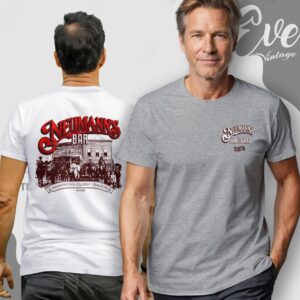
- North St. Paul (Neumann's Bar): Operating at 2560 7th Avenue East since 1887, this is legally recognized as Minnesota’s oldest continuously operating bar. Originally backed by the historic Hamm’s Brewery to establish a local outlet, the centerpiece of the saloon remains its exquisite, late-19th-century wooden back bar. During Prohibition, the venue survived by selling near-beer downstairs while operating a covert speakeasy upstairs, complete with a keyhole window and a secret phone line connecting to the main bar to alert patrons of incoming raids. In the 1930s, the bar added its famous signature trademark: a small live frog pond built directly into the front window vestibule, a tradition that survives today alongside icy-cold taps of Hamm's beer.
- South Minneapolis (Matt's Bar): Established in 1954 on Cedar Avenue, this iconic landmark is a foundational pillar of Minnesota culinary and nightlife history. Taking over a 1914 structural footprint previously known as Nibs, founder Matt Bristol created the "Jucy Lucy"—a highly specific regional burger featuring molten hot American cheese sealed entirely inside two beef patties. Due to an infamous printing and signage error on the original menu layout, the letter "i" was completely dropped from the word "Juicy." The bar has permanently preserved this typo as a badge of local authenticity, operating with its classic 1950s iridescent wallpaper and a strict short-order flat-top grill policy under the legendary local warning: "Fear the Cheese."
- Uptown Minneapolis (CC Club): Located at 2600 Lyndale Avenue South, this legendary institution has held a 3.2% beer license since the very day Prohibition ended in 1933. Transitioning from the CC Tavern to the CC Tap, it solidified its place in counter-cultural history during the 1980s as the definitive ground zero for the Twin Cities' independent rock explosion. The bar served as the primary daily hangout and creative sanctuary for legendary bands like The Replacements, Hüsker Dü, and Soul Asylum. The Replacements' iconic anthem "Here Comes a Regular" was directly written about and inspired by their long afternoons spent inside the bar. The venue completely preserves its gritty rock-and-roll layout, featuring a classic wood-shingled half-roof exterior, circular red vinyl booths, and vintage pinball setups.
Minnesota Drinking Culture & Design Context
Why is the word "Jucy" deliberately misspelled on Minnesota apparel designs?
The spelling "Jucy Lucy" without the "i" refers explicitly to the historical menu misprint at Matt's Bar in South Minneapolis. On apparel, using this specific spelling serves as a direct marker of local authenticity that distinguishes true Twin Cities folklore from generic commercial imitations. Graphic designs focusing on this motif rely on mid-century short-order line art and retro typography rather than modern digital vector styles.
What is the cultural history behind the "Here Comes a Regular" and red booth motifs?
This graphic layout draws directly from the physical interior of the CC Club in Uptown Minneapolis. The reference honors the 1980s underground punk and indie rock movement where songwriters used the bar's circular red booths and low-light atmosphere as a creative refuge. Incorporating these specific structural symbols and lyrical nods on apparel grounds the garment in genuine local music history rather than corporate rock tropes.
How do Twin Cities urban dive graphics and Greater Minnesota northwoods designs differ visually?
Twin Cities urban dive graphics focus on gritty music and culinary history, utilizing high-contrast layouts, graffiti textures, bold sans-serif block fonts modeled after old ticket stencils, and palettes dominated by asphalt black, neon green, and faded red. Conversely, Greater Minnesota and Northwoods designs lean entirely into frontier extraction and wilderness survival: featuring weathered wood-grain patterns, imagery of white-tailed deer or vintage brewery bears, and desaturated tones like pine green, iron rust, and lake blue inspired by the state's outdoor heritage.