
Dive Bar
Lafitte’s Blacksmith Shop: Where Dive Bar Culture Meets New Orleans Legend
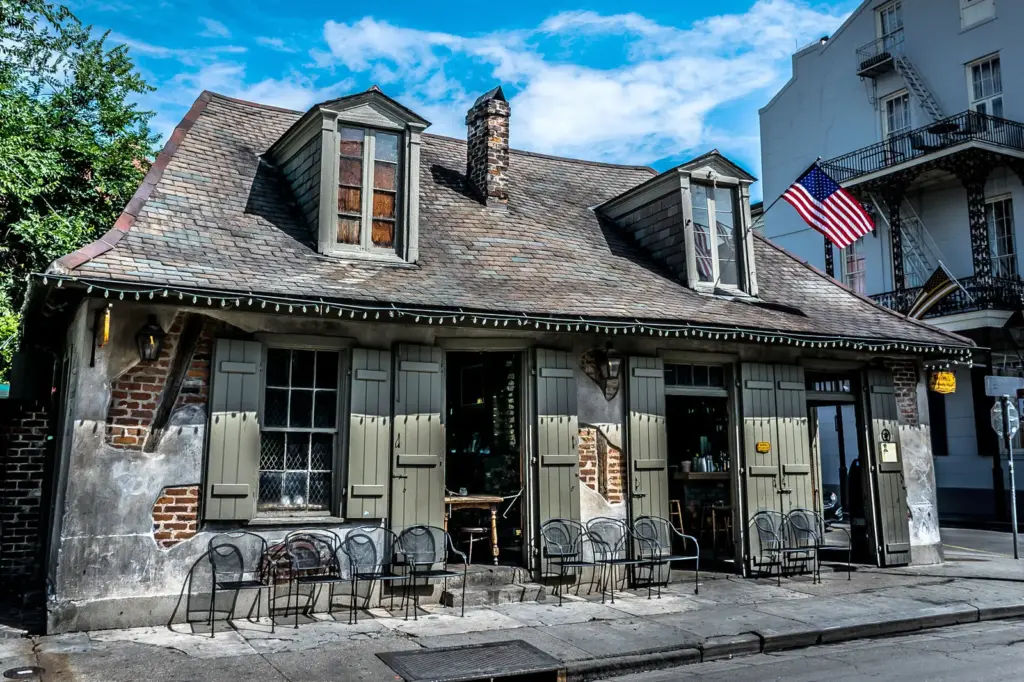
This is Lafitte’s Blacksmith Shop Bar, one of the most recognizable drinking establishments in New Orleans. It is often introduced as the oldest bar in the United States, the former headquarters of a legendary pirate and one of the French Quarter’s most haunted buildings. Every part of that description contains a mixture of history, interpretation and folklore.
But Lafitte’s is interesting for a reason that has little to do with winning an argument over which American bar is the oldest. The place reveals how New Orleans treats its past: not as something sealed behind museum glass, but as something people continue to drink in, sing in, exaggerate and reinvent.
It also raises an unusual question for anyone interested in American drinking culture:
Can a nationally known tourist attraction still possess the soul of a dive bar?
A Different Side of Bourbon Street
Lafitte’s Blacksmith Shop stands at 941 Bourbon Street, on the corner of Bourbon and St. Philip streets in the French Quarter. It is far enough from the brightest clubs and largest crowds near Canal Street that arriving there can feel like reaching an older, darker version of Bourbon Street.
The building does not resemble the ornate townhouses with cast-iron balconies that define much of the Quarter today. It is lower, rougher and visibly older. Its roof appears disproportionately large above the small façade, while exposed brick, wooden shutters and irregular surfaces give the impression that the structure has survived by refusing to become elegant.
That impression is not entirely manufactured.
The National Park Service lists Lafitte’s Blacksmith Shop as a historic building whose primary national significance is architectural. It was designated a National Historic Landmark in 1970, with its period of significance placed in the second half of the eighteenth century.
In a neighborhood filled with businesses that deliberately imitate age, Lafitte’s occupies a building that genuinely belongs to colonial New Orleans.
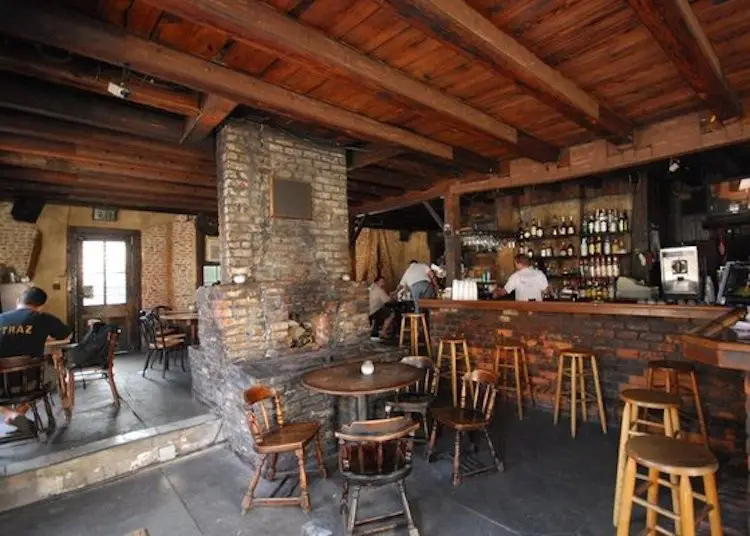
Its imperfections are therefore part of the experience. The worn wood, exposed masonry and low light do not function merely as decoration. They give the bar the quality that the best dive bars acquire over time: a personality created less by coordinated design than by accumulated use.
Is Lafitte’s Really a Dive Bar?
There is no universally accepted definition of a dive bar. The term usually describes an unpretentious neighborhood drinking place with simple service, modest surroundings, a regular clientele and little interest in presenting itself as fashionable.
By that standard, Lafitte’s is not a pure dive.
It is internationally known, prominently featured in travel guides and surrounded by pirate stories, ghost tours and claims about being America’s oldest bar. Many guests arrive specifically to photograph the building rather than to disappear anonymously into a neighborhood watering hole. Its location on Bourbon Street makes it part of one of the most heavily visited nightlife districts in the country.
Yet the bar retains much of what people seek in a dive.
The room is dark. The furniture does not dominate the experience. The building has not been polished into a luxury historical attraction. Drinking remains casual, and the piano-bar atmosphere can turn strangers into a temporary community. Its identity depends on mood, memory and human participation rather than an elaborate cocktail concept.
Lafitte’s might therefore be described more accurately as a meeting point between three traditions:
the neighborhood dive bar, the historic tavern and the tourist landmark.
That uneasy combination is central to its appeal. It is both more commercial than the classic local dive and less controlled than a carefully restored heritage bar. The tension is visible everywhere: candles beside modern equipment, colonial walls behind frozen drinks and old pirate folklore repeated to new groups of visitors every night.
Rather than disqualifying Lafitte’s from dive-bar culture, those contradictions reveal how a dive can change when the wider world discovers it.
The Building Is Older Than the Bar
The most repeated claim about Lafitte’s is that it was built between 1722 and 1732 and is the oldest structure in the United States still operating as a bar. The bar’s official history presents that early construction date and describes the building as an example of the French Louisiana technique known as briquette-entre-poteaux—brick placed between heavy timber posts.
Historical property research presents a more cautious account.
According to the Preservation Resource Center of New Orleans, the exact construction date remains uncertain, but the building belongs to the Spanish Colonial period. Carpenter Bartholomie Robert and his family owned the property from 1773 until 1833, and an estate record from 1781 mentions a small house standing there.
That evidence makes a construction date in the 1770s more defensible than the frequently advertised 1720s date.
The distinction matters. Lafitte’s may occupy one of the oldest surviving buildings used as a bar, but the building itself did not operate continuously as a drinking establishment from the eighteenth century onward. Before becoming a bar in the twentieth century, it reportedly served at different times as a residence, workshop and ice cream parlor.
Calling it “the oldest bar in America” therefore compresses several separate claims into one convenient slogan:
- The building is extremely old.
- It is now used as a bar.
- A drinking establishment has occupied it since the twentieth century.
- Its alleged connection to Jean Lafitte gives it an even older tavern-like identity.
The first three statements can be discussed through records. The fourth belongs largely to legend.
Correcting the timeline does not make the place less interesting. In some ways, the truth is more revealing. Lafitte’s represents adaptive reuse before that phrase became fashionable: an eighteenth-century domestic structure that continued to survive because later generations found new uses for it.
New Orleans did not preserve the building by removing life from it. The city preserved it by continuing to inhabit it.
The Blacksmith Shop Legend
The story most visitors hear is that the cottage once served as a blacksmith shop operated by the brothers Jean and Pierre Lafitte. According to the legend, the forge provided a respectable front for a much larger criminal enterprise. Stolen or smuggled goods arrived through the Lafittes’ network and were stored, negotiated or sold from the property.
More elaborate versions introduce hidden passages connecting the building to the Mississippi River.
There is no concrete documentary evidence that Jean or Pierre Lafitte owned or operated at 941 Bourbon Street. Historical research has found a city license issued to Pierre Lafitte in 1813 for a butchery at the corner of Bourbon and St. Philip, but there is a strong possibility that the license referred to a different building nearby. Underground passages are even less plausible in a city defined by low elevation and a high water table.
The legend is not simply a recent invention created for tourists, however.
By 1883, the writer Lafcadio Hearn was already referring to the property as the famous smithy of the Lafitte brothers. A New Orleans guide published in 1885 repeated the association. The story had therefore entered the city’s cultural memory generations before the present bar developed its modern tourist identity.
This distinction is important. A story can be historically unproven and still possess a genuine history of its own.
For more than a century, New Orleans residents, writers, bar owners and visitors have attached the Lafitte name to this cottage. The legend has shaped the building’s identity, influenced how people interpret its fireplace and dark corners, and helped preserve public interest in the structure.
The connection may not be documented fact, but it has become cultural fact.
Jean Lafitte: Pirate, Privateer and New Orleans Antihero
Jean Lafitte is often reduced to the romantic image of a pirate captain, but the real figure was more complicated and far less innocent.
Lafitte called himself a privateer rather than a pirate. Privateers operated with government authorization to attack enemy vessels, while pirates acted without legal authority. Lafitte received letters of marque connected to Cartagena’s rebellion against Spain, but the United States did not recognize that government’s authority and accused his men of attacking ships beyond any legitimate commission.
By 1812, Lafitte led the Baratarians, a network based around the swamps, bayous and barrier islands south of New Orleans. The organization handled smuggled merchandise, operated warehouses and participated directly in the trafficking and sale of enslaved people. The National Park Service notes that Lafitte used locations outside New Orleans for auctions designed to evade the law.
Any modern retelling that presents him only as a charming rogue leaves out the people harmed by his business.
Yet Lafitte also became associated with the defense of New Orleans during the War of 1812. British officials sought his assistance for an attack through the Gulf and offered money, land and military rank. Lafitte did not accept their proposal. After extended negotiations with American officials, hundreds of Baratarians contributed manpower, supplies, knowledge and artillery skills to the American campaign that culminated in the Battle of New Orleans in January 1815.
This transformation—from wanted smuggler to useful defender—made Lafitte ideal material for legend.
He could be portrayed as both an outsider and a patriot, a criminal who knew the city better than the authorities pursuing him, and a man who helped defend the society whose laws he repeatedly violated.
That moral ambiguity is deeply compatible with New Orleans folklore. The city has rarely demanded that its legendary characters be respectable. It often remembers them because they crossed boundaries: between nations, languages, races, legal systems and social worlds.
Why the Legend Belongs to New Orleans
Many cities have old buildings. New Orleans distinguishes itself through the way it allows documented history and folklore to occupy the same room.
At Lafitte’s, the official record says that the cottage is a rare colonial structure. Popular memory says it was a pirate headquarters. Ghost stories say Jean Lafitte may still appear near the fireplace. The modern bar adds piano music, candles and alcohol, creating exactly the conditions in which the distinctions between those stories begin to soften.
This does not mean that facts are unimportant. On the contrary, the real history becomes more compelling when the legend is identified honestly.
The building’s architecture connects it to colonial construction traditions. Its uncertain age reflects the fragmentary records of an old port city. The pirate story preserves the memory of New Orleans as a center of smuggling and maritime commerce. The ghost stories express a broader belief that the past remains physically present in the French Quarter.
Lafitte’s therefore acts as a small model of New Orleans itself: French and Spanish, American and Caribbean, sacred and commercial, theatrical and sincere.
Even the exposed materials carry symbolic weight. Brick and timber represent survival. The fireplace evokes labor, contraband and the supposed blacksmith operation. Candlelight turns architectural decay into atmosphere. The piano changes a historical structure from an object to be observed into a social space to be joined.
The bar does not simply tell visitors what New Orleans used to be. It demonstrates how the city continues to manufacture identity from whatever history has left behind.
Café Lafitte and a Lesser-Known Queer History
The pirate narrative often overshadows a more recent and better-documented chapter in the building’s history.
In 1933, the former cottage became the original location of Café Lafitte. The bar developed a mixed clientele that included gay men, lesbians, heterosexual patrons, artists and members of the French Quarter’s bohemian community.
This was significant in a period when openly LGBTQ+ social spaces faced legal pressure, police attention and widespread hostility. Bars provided rare environments in which communities could meet, build relationships and create forms of public life unavailable elsewhere.
In 1953, the business moved to 901 Bourbon Street and adopted the name Café Lafitte in Exile. The later establishment became closely associated with New Orleans LGBTQ+ history and has claimed the distinction of being the oldest continuously operating gay bar in the United States. Writers including Tennessee Williams and Truman Capote have been connected with its history.
The word “Exile” turned a business dispute and forced relocation into a lasting identity. It suggested displacement, survival and the creation of a new home by people pushed away from an earlier one.
This chapter expands the meaning of the Lafitte name beyond pirates and privateers. The original building was also part of the social geography through which artists and LGBTQ+ residents helped shape the modern French Quarter.
That history belongs in any serious account of the bar because it shows that Lafitte’s cultural importance did not end with the colonial period. Different generations have used the same structure to create different forms of refuge, entertainment and community.
Candlelight, Piano Music and the Modern Bar
Today, Lafitte’s succeeds because it has not been converted into a conventional historical museum.
People still drink there. Conversations overlap. Piano music competes with voices. The room can shift between intimate and chaotic depending on the hour and the crowd. Visitors encounter history through use rather than through silence.
The atmosphere is also carefully reinforced. Darkness obscures modern alterations. Candles make rough surfaces appear older and deeper. The fireplace provides a visual anchor for the blacksmith story, regardless of whether that story can be proven. The hanging “Piano Bar & Lounge” sign connects the building’s colonial exterior with its twentieth-century nightlife identity.
None of this makes the experience inauthentic. Every long-lived bar eventually learns how to perform its own character.
A neighborhood dive preserves old signs, damaged furniture and stories about former regulars. Lafitte’s does something similar on a larger scale. It preserves a version of itself assembled from architecture, local legend, bar culture and visitor expectation.
The result is neither completely spontaneous nor completely staged.
It is New Orleans.
Is Lafitte’s Worth Visiting?
Anyone expecting an undiscovered neighborhood bar may find Lafitte’s too famous. Anyone expecting a perfectly documented pirate site may be disappointed by the historical uncertainty. Visitors seeking a refined cocktail temple may also misunderstand the purpose of the place.
Lafitte’s is most rewarding when approached as a living cultural artifact.
Go to see how an eighteenth-century building continues to function inside a modern nightlife district. Notice the structure before concentrating on the legends. Consider why generations of New Orleanians kept repeating the Lafitte story. Listen to how the room changes when the piano draws strangers into the same song.
Most importantly, accept the contradictions.
The bar is historic and commercial. It is rough but carefully atmospheric. It belongs to tourists, yet it carries memories of local bohemian and LGBTQ+ communities. Its most famous story may not be literally true, but the persistence of that story reveals something true about New Orleans.
More Than America’s “Oldest Bar”
The phrase “oldest bar in America” is memorable, searchable and easy to print on souvenirs. It is also too small to explain Lafitte’s Blacksmith Shop.
The real significance of the place lies in everything that refuses to fit neatly into the slogan.
It occupies an authentic colonial building wrapped in a questionable pirate legend. It celebrates Jean Lafitte while forcing a closer look at the violence and human exploitation within his career. It combines the social informality of a dive bar with the visibility of a major tourist destination. It links the maritime folklore of the nineteenth century to the bohemian and queer nightlife of the twentieth.
Lafitte’s survives because New Orleans never required it to choose between those identities.
The city allowed the cottage to become a workshop, a residence, a bar, a legend and a stage. Each generation added another layer without completely removing the one beneath it.
That is why Lafitte’s matters to the history of dive bars.
The best dive bars do more than serve inexpensive drinks in worn rooms. They hold fragments of a neighborhood’s memory. Their stories accumulate through owners, regulars, musicians, rumors and nights that nobody documented properly. They become cultural records precisely because they were never designed to be archives.
At Lafitte’s Blacksmith Shop, that process has been unfolding for centuries.
Whether Jean Lafitte ever crossed its doorway may remain uncertain. But the building has become something larger than a pirate relic: a place where New Orleans continues to drink with its past.
Very well presented. Every quote was awesome and thanks for sharing the content. Keep sharing and keep motivating others.
I loved as much as you will receive carried out right here The sketch is attractive your authored material stylish nonetheless you command get got an impatience over that you wish be delivering the following unwell unquestionably come more formerly again since exactly the same nearly a lot often inside case you shield this hike
This was beautiful Admin. Thank you for your reflections.
This is my first time pay a quick visit at here and i am really happy to read everthing at one place
This is my first time pay a quick visit at here and i am really happy to read everthing at one place
This is really interesting, You’re a very skilled blogger. I’ve joined your feed and look forward to seeking more of your magnificent post. Also, I’ve shared your site in my social networks!
Great information shared.. really enjoyed reading this post thank you author for sharing this post .. appreciated
I’m often to blogging and i really appreciate your content. The article has actually peaks my interest. I’m going to bookmark your web site and maintain checking for brand spanking new information.
This was beautiful Admin. Thank you for your reflections.